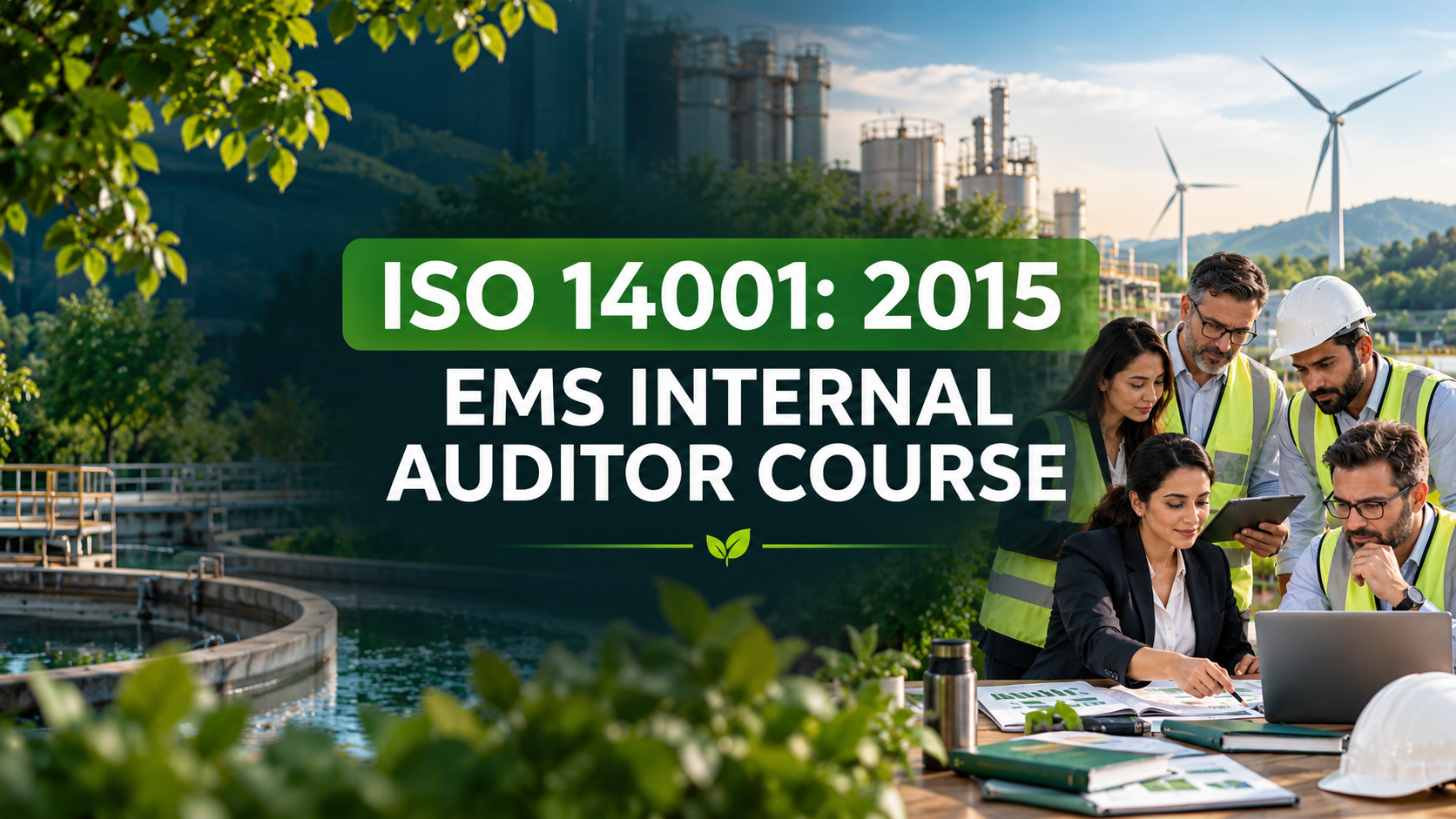
ISO 14001:2015 Environmental Management System Auditing – Requirements, Evidence and Practical Application
Created by SF Trainings Team
This Internal Auditor course provides learners with a practical understanding of Environmental Management Systems (EMS) and the skills required to evaluate their implementation and effectiveness. It covers organizational context, environmental policy, leadership, environmental aspects and impacts, risks and opportunities, objectives and KPIs, life cycle perspective, competence, documented information, operational controls, emergency preparedness, monitoring, internal audit programmes, management review, nonconformity, corrective action, and continual improvement. Learners will develop the ability to plan and conduct internal EMS audits, collect and evaluate objective evidence, identify gaps and nonconformities, assess corrective actions, and support continual improvement of environmental performance.
You will learn to:
EMS Fundamentals
Understand the purpose, structure, and key elements of an Environmental Management System.
Organizational Context
Evaluate internal and external issues, environmental conditions, and interested-party expectations.
EMS Scope
Review how the organization defines and maintains the scope of its Environmental Management System.
Leadership & Policy
Assess leadership commitment, environmental policy, roles, responsibilities, and accountability.
Environmental Aspects & Impacts
Identify and evaluate environmental aspects, impacts, and significance.
Risks & Opportunities
Assess environmental risks and opportunities and how they are addressed within the EMS.
Environmental Objectives & KPIs
Review measurable objectives, targets, indicators, responsibilities, and action plans.
Life Cycle Perspective
Evaluate relevant upstream and downstream environmental considerations.
Competence & Awareness
Assess employee competence, awareness, responsibilities, and training effectiveness.
Communication
Review internal and external environmental communication processes.
Documented Information
Verify the control, availability, accuracy, and use of EMS documents and records.
Operational Planning & Control
Assess how significant environmental aspects and risks are controlled in operations.
Emergency Preparedness
Evaluate emergency response procedures, training, drills, and follow-up actions.
Monitoring & Measurement
Review environmental performance data, trends, KPIs, and monitoring controls.
Performance Evaluation
Determine whether monitoring results are used to evaluate EMS effectiveness.
Internal Audit Planning
Define audit objectives, scope, criteria, methods, responsibilities, and schedules.
Audit Evidence
Collect and evaluate objective evidence through interviews, observations, and records.
Audit Findings
Identify conformity, nonconformity, weaknesses, and opportunities for improvement.
Management Review
Evaluate management review inputs, decisions, actions, and follow-up.
Corrective Action
Assess root cause analysis, corrective action implementation, and effectiveness.
Continual Improvement
Evaluate how the organization improves EMS performance and overall effectiveness.
Audit Reporting
Develop clear, evidence-based internal audit findings and conclusions.
Follow-Up Audits
Verify that identified issues and corrective actions have been effectively addressed.
Join thousands of learners and build in-demand skills.